.png)
Sickle Cell & School :: What Educators Need to Know
- thescak
- Jul 10, 2025
- 3 min read
What is Sickle Cell Disease?
Sickle Cell Disease (SCD) is an inherited blood disorder. Normal red blood cells easily carry and deliver oxygen to vital tissues and organs. People with a hemoglobin disease, SCD, have red blood cells that are sickle shaped, which causes difficulty carrying and delivering oxygen, resulting in complications.

Who Does SCD Affect?
Up to 400,000 babies with severe forms of hemoglobin disorders are born worldwide each year.
Over 2,000 babies are born each year in the United States, making it the most common inherited blood disorder.
Those with reduced access to adequate healthcare are affected more severely.
Anyone with blood that inherits the gene mutation from both parents.
Anyone of any color, ethnicity or race, geography, or belief.
What Type of Complications?
Anemia
Episodes of pain, mild to severe (pain crisis)
Swollen hands and feet
Frequent infections
Delayed growth or puberty
Vision problems
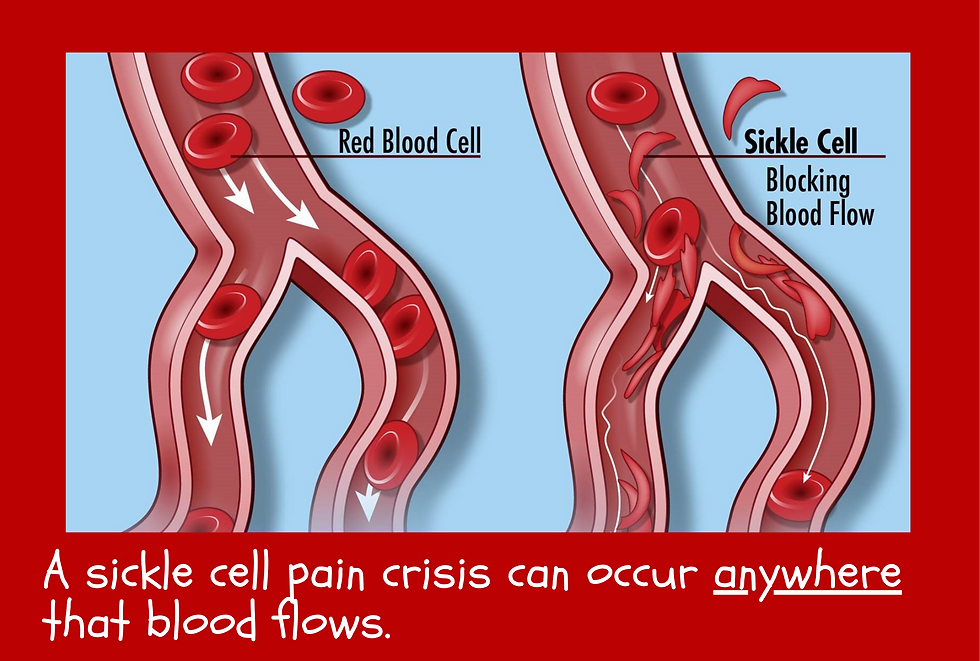
Vaso-Occlusive Crisis aka Pain Crisis
The most common crisis in Sickle Cell Disease is a vaso-occlusive crisis (VOC). These occur when sickled red blood cells block blood vessels, causing mild to very severe pain and organ damage. Pain will often last for hours or days.
Unfortunately, there is no laboratory test that can definitively determine if a Sickle Cell patient is having a vaso-occulsive pain crisis.
What Can Trigger a Crisis?
Factors that may trigger a crisis include:
dehydration
high altitudes
cold environment (such as the classroom)
drastic changes in temperature
swimming in cold water
arduous physical labor/activity
stress
menstrual cycle
How Can SCD Affect School?
Students with sickle cell disease may miss class time or be absent for doctor visits, hospital stays, or blood transfusions.
Students may appear distracted or unmotivated to learn. Chronic fatigue or pain can affect students' ability to learn.
What About Sickle Cell Trait (SCT)?
Children with SCT can also experience complications like those with SCD, but typically to a lesser degree. Children with SCD & SCT should always take precautions when playing contact sports or participating in strenuous exercise.

How Can I Help?
Your student may:
need to carry a personal water bottle
ask for breaks from instruction and activities when necessary, due to fatigue
need frequent breaks to see the nurse to help manage their pain.
need frequent bathroom breaks (due to required fluid intake)
want a sweatshirt or jacket with them at their desk
need to take breaks during recess, PE, or other activities that require physical exertion.
Allow students to have accommodations like:
extensions for homework and projects,
rescheduling tests (due to absences or appointments).
re-do low homework grades to help improve mastery of content
extra instructional time when needed
These may help reduce stress, which will help manage their symptoms.
What Are the Symptoms of a Sickle Cell Pain Crisis?
Pain can range from mild to severe, so sometimes a visit to the school nurse for medication is all that is needed.
But remember, pain crisis can occur anywhere that blood flows. This includes all vital organs. Symptoms that need immediate medical care are:
severe pain
chest pain, with or without a cough
trouble breathing
fever
jaundice or paleness, in eyes or skin
extreme tiredness
swelling of hands and feet
severe headaches
seizures
enlarged spleen
other neurologic symptoms (such as sudden vision changes, slurred speech, weakness or inability to move a part of the body, or loss of consciousness).
Quiz

Note to School Staff:
Sickle Cell Disease is a serious health condition and students should be taken seriously when they indicate discomfort or request to see the school nurse. Sickle Cell Disease is a chronic, life-long disease. This means that these children may ALWAYS be experiencing some level of pain, so when the pain is bad enough for them to tell you.... LISTEN!!
This is for informational purposes ONLY! PLEASE seek a healthcare provider if you experience any of these symptoms or think you may have SCD/SCT. This is not intended to be medical advice.

